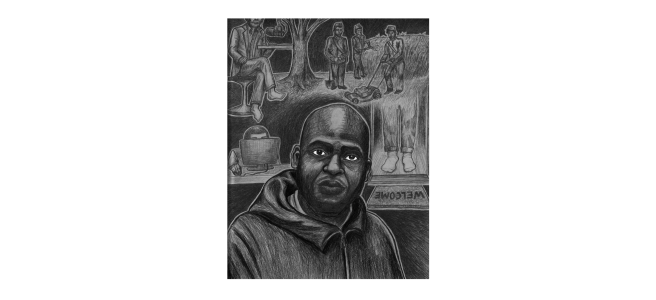
Image credit: Billy Dee
Today is Tuesday. That’s not actually true. Well, it might be. It depends. The truth is, well, complicated sometimes. Kiese Laymon, who describes himself as a “Black southern writer,” is an English professor and winner of several prestigious awards including the 2022 MacArthur Genius Grant. His novels and essays explore conditions of race, class, body image, and more. In this 2019 essay from Scalawag magazine, he deftly employs the refrain “that’s not actually true” to explore some of the jagged boundaries between experience and expectation, reality and perception, and history and possibility, all regions where everything gets tossed together in a jumble of contradictions. His conclusion makes clear, however, that what he is actually addressing are the effects of centuries of racism embodied in the inner life of a 21st century Black southern writer.
Read it here.
EXPLORE, REFLECT, SPEAK UP.
1. At four points in his essay, Laymon draws a contrast between “intellectual class” and “economic class.” First, what does he mean by each of those terms? In what ways are those two types of class in contrast with one another? Are the four repetitions of those terms effective? Confusing? Not adequately explained? Something else? Explain your response. Point to an example from the essay that provides more detail about what the contrast means.
2. Several times in the essay, Laymon displays his personal vulnerability; for example, when he arrives at the place where he is going to record audio and he is unsure about taking off his shoes. Point out one other example where Laymon exposes himself in this way. Do you think the choice to reveal his vulnerability damages his credibility as an author? Why or why not? What might have been his purpose in presenting himself that way? Do you think he accomplishes his purpose? Why or why not?
3. LET’S TALK. Laymon uses a variety of terms to refer to people: brother, sister, man, woman, person, folks. He also uses the race references Black/black and white, and it is not always true that he combines “black” with brother/sister and “white” with man/woman, as a casual reader might expect. Are the references random or can you find some design, some additional meaning, in the instances when he refers to someone as a “brother” or “sister” and when he uses “man” or “woman”? Work with a few classmates to analyze the essay and seek out patterns and meanings in the ways that Laymon refers to the persons he describes. In your group, discuss your process and results. Was this a difficult task? Why or why not? Did you find any surprises?
4. AND NOW WRITE. Some of the words and descriptions that Laymon uses with apparent nonchalance are often considered too vile to be spoken in polite, public discourse. Still, what he writes comes from the everyday reality of many people, many of whom genuinely strive to redress the vileness, to prevent it from continuing. Some might argue that problems must be named and acknowledged before they can really be solved. What do you think about Laymon’s casual use of “the N-word,” for example, and his blunt depictions of everyday racism and its history in the US? Think about that question and then write a reflection essay in which you respond to it. It’s a complicated and difficult question, for sure, so don’t be afraid to express ambivalence. Do try to reflect with a wide mind and open heart.
 LetsTalkLibrary