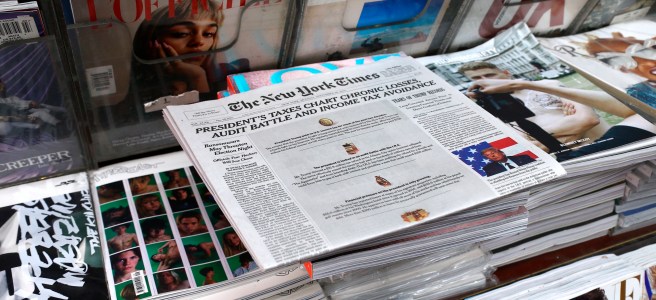
Image credit: Charles Guerin/Abaca/Sipa USA(Sipa via AP Images)
Do mainstream, large-circulation daily newspapers offer non-biased coverage of national news? Good question. Depending on whom you ask, responses will probably be Hard Yes, Hard No, and all points in between. To find a more concrete and precise answer to the question, a team of research analysts made a systematic study of the front pages of two major national newspapers, the New York Times and the Washington Post, during two specific periods leading up to national elections. David M. Rothschild is senior principal researcher at Microsoft Research; his four co-authors include academics and researchers. Their report was published by the Columbia Journalism Review, an online research and watchdog organization, in November 2023.
Read it here.
EXPLORE, REFLECT, SPEAK UP.
1. David Rothschild and colleagues focused their analysis exclusively on the front page of two newspapers during the period of investigation. Why did they choose such a narrow focus? Do you think that was a good choice for obtaining the information they sought? Why or why not?
2. Although the analysis presents abundant data, including statistics, the report is written exclusively in prose, without any tables or charts. Would graphic presentations of their data have been useful to you in comprehending the information? Imagine what kind of table you might have wished to see. How would you have organized the information? If it helps, you might even try drawing what you’re envisioning.
3. LET’S TALK. The report acknowledges that “the choices made by major publishers are not wrong, per se,” because no one can know how or how much to cover an issue while it is unfolding. They argue, however, that media outlets need to make “an earnest and transparent assessment of what they choose to emphasize.” What do you think that might look like? Are there media outlets that you know—broadcast or cable television, radio, YouTube channels, etc.—that are doing what Rothschild and colleagues recommend? Work with a few classmates to compare and evaluate the media that you are familiar with. How transparent are they in letting their public know how they make their choices about what to cover? How important is transparency and disclosure to you? Listen open-mindedly to your classmates’ opinions.
4. AND NOW WRITE. Rothschild and colleagues concluded that both newspapers in their investigation emphasized the “horse race” aspects of the election campaign and that the coverage “functioned more to entertain readers than to educate them on essential differences between political parties”; the authors suggest that it is the responsibility of the newspapers to educate the public about issues of importance in an election campaign. Do you agree? Is educating the public a legitimate responsibility of news media? Why or why not? Write an essay in which you take a position on that question. (HINT: You may want to use this reading or any of the others in your textbook or in the Let’s Talk Library as evidence to support your argument.)
5. CROSS-TALK. Read (or re-read) Lewis Raven Wallace’s essay in your textbook. If Rothschild and colleagues wanted to expand their argument and quote something from Wallace’s essay what passage might they choose? Why? Does that passage support or refute Rothschild et al.’s main argument?
 LetsTalkLibrary