Image credit: Roz Chast, Instagram
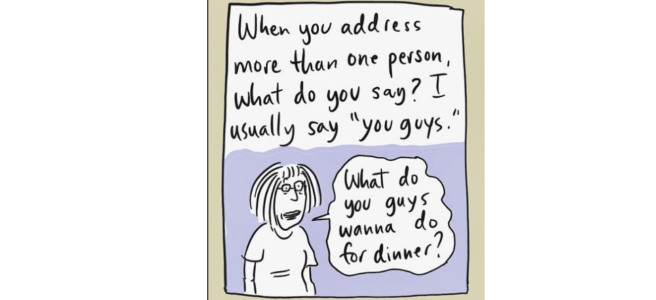
Hey, you guys! Is this an expression you might use to address more than one person? If so, see what cartoonist Roz Chast has to say about that in this cartoon posted on Instagram in November, 2024. Chast is an award-winning cartoonist who is also a fellow of the American Philosophical Society. A philosophical cartoonist? A cartoonist philosopher? You decide!
Read it here.
1. Have you ever thought much (or at all!) about how you address more than one person? Do you ever refer to them as “you guys”? Once upon a time a guy was defined as a male, but for a long time now, it’s been defined (at least in dictionaries) as a male or female. Roz Chast says she’s not bothered by the “gender aspect”; are you? And if so, why—or why not? And what about Chast: What’s her problem with “you guys”?
2. Chast considers some alternatives to “you guys” in her cartoon, and her post on Instagram has sparked 527 comments and counting, most of them suggesting other alternatives: friends, everyone, ladies and gentlemen, dudes (and one we really like: to switch to French or Spanish, problem solved!) Brainstorm as many alternatives as you can—ones you’ve heard before as well as ones you come up with yourself—and then note where each one would be most useful or appropriate.
3. Chast seems to be complaining about the intricacies of English grammar. If this were an essay, she would likely conclude with a call for readers to think or do something. But this is a cartoon, and while she may want something to be done, she also wants to make us laugh. (Hence her “Dear Whom” memo, which points to another annoying language issue, the difference between “who” and “whom,” and also gives us a good chuckle.) What exactly is her argument—and how can you tell?
4. LET’S TALK. Working with several classmates, have one person read the words of this cartoon aloud while the rest of you close your eyes and listen. Then take a close look at the drawings. Are they an essential part of the message Chast is sending? If so, what specifically do they add?
5. AND NOW WRITE. What is something that you find to be “very, very, very annoying” about English or some other language—something that gets on your nerves about the way the language works or is used. Write a brief description of this annoying usage, explain why it annoys you, and propose some ways to “fix it.”
 LetsTalkLibrary