Image credit: TED
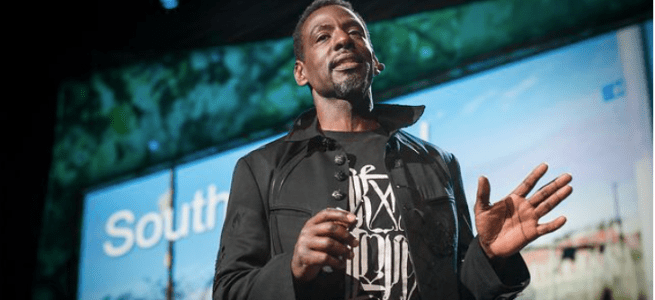
How would you feel if you had no way of getting healthy food? Not good, right? That was the situation in South Central Los Angeles, one that Ron Finley set out to correct. He started by planting a vegetable garden on a strip of land between his house and the street. His 2013 TED Talk describes what happened after that.
Watch it here.
EXPLORE, REFLECT, SPEAK UP.
1. Ron Finley opens by announcing that he lives in South Central, “home of the drive-thru and the drive-by”—and then he says “funny thing is, the drive-thrus are killing more people than the drive-bys.” Obviously that’s no joke, but how—and why—did this opening get your attention?
2. Finley’s talk is a narrative, about how he got tired of seeing people dying, “figured that food was the problem…and the solution,” and started planting gardens around LA. But it’s a story with a point. What is Finley’s argument, and what reasons and evidence does he provide to support that argument?
3. Finley’s TED Talk includes many visuals—photos of South Central, of some of the gardens, and even of some of the data he references. The transcript of his talk does not include these images. Compare the two: read the transcript of his talk, paying attention only to his words. Then listen to his talk, paying attention to both the words and photos. Do the images support his points in ways that words alone do not—and if so, how?
4. LET’S TALK. Did you notice how much Finley uses repetition in his talk? Sometimes it’s words (“…liquor stores, fast food, vacant lots….Liquor stores, fast food, vacant lots.”), sometimes it’s sentence structure (“I grew up there. I raised my sons there.”). Together with a classmate or two, watch his talk, paying attention to when and how he repeats something. Can you see any patterns for what he chooses to repeat—and why? In short, how does the use of repetition affect his message?
5. AND NOW WRITE. Think about a neighborhood you know: one you grew up in, one nearby or on campus, or another one you know well. How does that neighborhood stack up in terms of the availability of healthy food? What does it have to offer its citizens, and what might it lack? Write a couple of paragraphs comparing that neighborhood to the one described by Finley. Are there changes you might propose that would serve its citizens more fully? What are they?
 LetsTalkLibrary