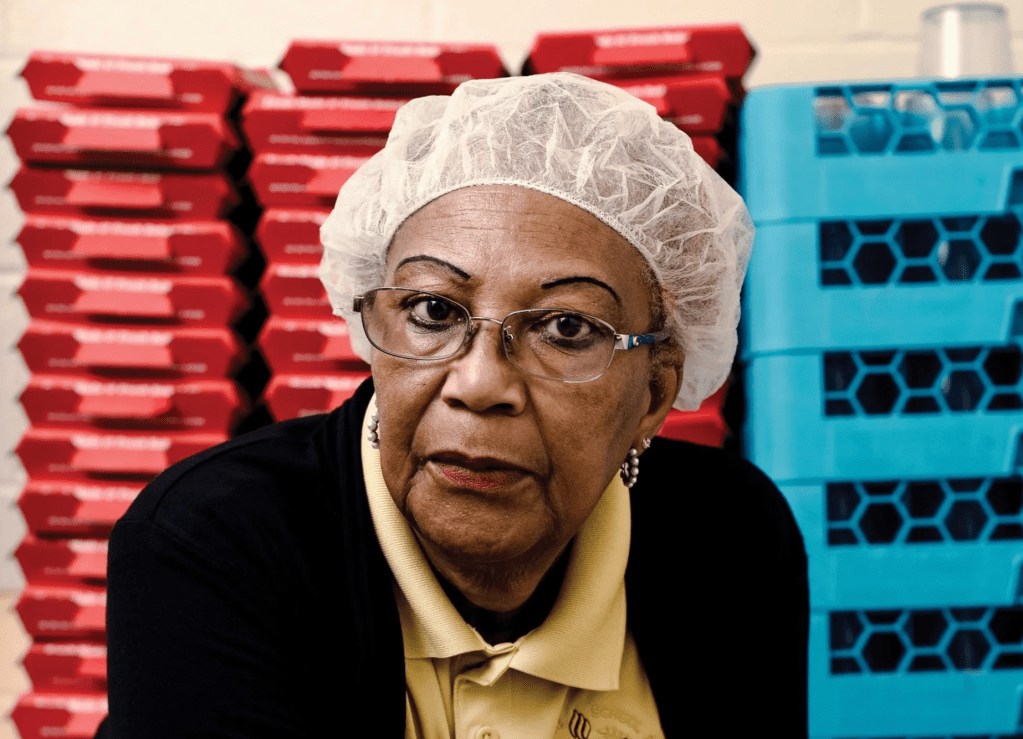
Image credit: Houston Cofield | The Bitter Southerner
Do you remember eating lunch in the school cafeteria? If so, did you have any favorite foods, and do you remember any of the ladies who worked in the lunch line? Maybe you’ve heard jokes about both the food and the “lunch ladies” who serve it (think Adam Sandler singing “yesterday’s meatloaf is today’s Sloppy Joes” in a song called “Lunch Lady Land”). But have you ever stopped to think about what it takes to get the food for that meat loaf into the schools—and about what those women do to make sure that every student gets lunch? Jennifer Justus has. She’s a food writer whose grandmother worked in a school cafeteria, and she’s written this photo essay analyzing the politics and policies that make getting food to the schools so complicated and describing how lunch ladies ensure that no students go hungry—arguing that these women are in fact “heroes of the school lunch line.” This essay first appeared in 2025 in The Bitter Southerner, a media company that publishes stories, books, and photo essays about the American South.
Read it here.
- Jennifer Justus opens by saying that “Granny won me over with the government cheese.” A curious statement, and one that sets up the argument the essay goes on to make about school cafeteria workers and their dedication to the students they feed. The cheese, she tells us in the third paragraph, “is part of the point.” How so? What exactly is her point, and what kinds of evidence does she provide to support that point?
- This essay includes quite a few photos of lunch ladies, images which are an essential part of the text. How do these images function rhetorically: What do they contribute that words alone might not? Why do you think the author chose to include them? What do you think about the style of the portraits and how the women are posed? In what ways do these images affect the way you experience and understand the article?
- LET’S TALK. Justus notes that various aspects of school lunch programs have been debated for decades. While most people agree that students need access to food at school, the details of how this is achieved pose real challenges. With a partner or in a small group, research some recent articles, perhaps from your own community, about public school lunch programs. As you read, consider the following: What issues are being discussed? Are they similar to the concerns Justus raises? Do you notice any challenges or perspectives that differ from those she describes? Who is quoted or interviewed—school staff? students? parents? policymakers? others? Justus quotes several people who cite cuts in government funding as a major problem; does she or any of the sources you find quote any government officials for their perspective? If not, should they? Discuss your findings, focusing on the issues that are being discussed and the people who are represented.
- AND NOW WRITE. School lunch programs involve many stakeholders—from policymakers and school administrators to cafeteria staff, students, families, and communities. Choose one group you want to address about the need for greater support for school lunch programs—politicians and those making budget decisions, school administrators, students, cafeteria staff, parents, or some other group. Consider how you can best reach this audience—in a letter? an op-ed? a speech at a PTA meeting? a classroom presentation? What do you want them to think about, and what do you want to say to them? What kinds of information, stories, or other evidence will be most important to include? Draft your piece with these choices in mind.
 LetsTalkLibrary