
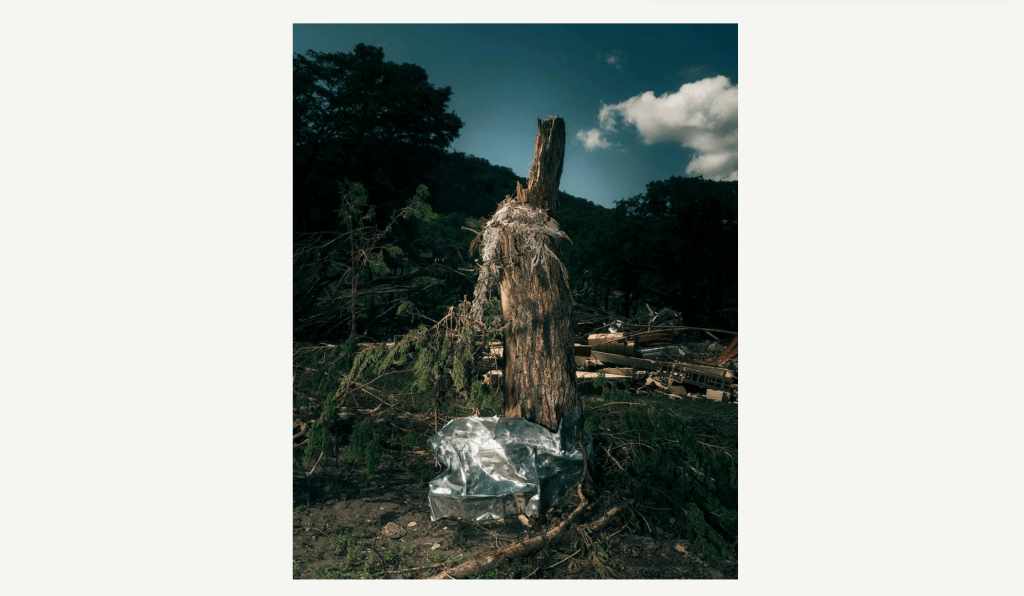
Image credit: Jordan Vonderhaar | TexasMonthly
No matter where you live, it’s a pretty good bet that you’ve experienced some extreme weather: heat waves, snowstorms or avalanches, tornadoes or hurricanes, cyclone bombs, drought, flooding. In 2006, Yale Climate Connections reported that the United States was facing a billion-dollar disaster roughly every two weeks. Aaron Parsley feels this statistic in his bones, as you’ll see in his first-hand account of the nightmare he and his family experienced during the deadly flooding of the Guadalupe River on July 4, 2025, when 135 people lost their lives. But statistics are just numbers, numbers that can scarcely capture what it feels like to be caught up in such an event, fighting to stay alive. With words and images, Parsley’s report takes us way beyond statistics, into the very eye of the storm he lived through. Parsley’s article was published on July 10, 2025 in the Texas Monthly, where he serves as a senior editor.
Read it here.
- Aaron Parsley’s report uses vivid description throughout to evoke his family’s ordeal, the narrative sometimes rushing along just as the river was, carrying readers along with it. But what do you think Parsley’s goals are—beyond that dramatic and hair-raising description? What point(s) or claim(s) do you see him making implicitly through his narrative? Read through the report again, searching for sentences or passages that suggest or imply such a point or claim and bring them to class for discussion.
- Parsley opens with an ominous eight-word sentence: “Rosemary, the four-year-old, woke up first.” Something bad is coming. Then after setting the scene—when and where they are, what the family had done that evening—Parsley chooses to proceed chronologically. The story rises and falls like the river, rising to the climactic moment when baby Clay is swept away and then subsiding as the survivors begin to find one another. The piece concludes with a coda, a letter from the author to his niece, little Rosemary. Why might Parsley have chosen this organizational pattern? He could have chosen a cinematic technique like flash-backs or flash-forwards rather than strict chronology, for example. Or he could have eliminated the letter to Rosemary. Note that he also chooses to use first-person reporting throughout. How do these rhetorical choices affect or help to shape your reading and understanding of his report?
- LET’S TALK. With several other members of your class, skim through Parsley’s article again, looking for what you agree is the most memorable passage—or more than one passage if you are not in complete agreement. Then talk about what makes the passage(s) so unforgettable. Consider Parsley’s choice of words (look especially at the verbs) as well as the rhythms he establishes: try reading the passage(s) aloud several times to one another, listening for the rhythm. Take a close look at punctuation, too, seeing if and how it helps create rhythm. What lessons might you take from this discussion for your own writing?
- AND NOW WRITE. Assume that you have read Parsley’s report in theTexas Monthly, where you can click on a speech bubble that will allow you to post a comment—in no more than 250 words. Write that comment, addressing Aaron Parsley directly, providing your overall response to his work and explaining, briefly, what in particular led to this particular response.
 LetsTalkLibrary