
A Cartoon: You Guys….

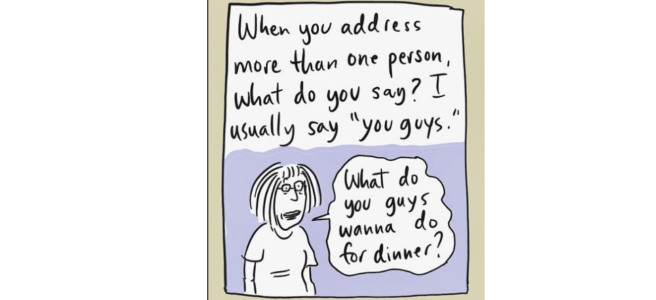
Image credit: Roz Chast, Instagram

Hey, you guys! Is this an expression you might use to address more than one person? If so, see what cartoonist Roz Chast has to say about that in this cartoon posted on Instagram in November, 2024. Chast is an award-winning cartoonist who is also a fellow of the American Philosophical Society. A philosophical cartoonist? A cartoonist philosopher? You decide!

Continue reading “A Cartoon: You Guys….”

How Bluey Became the Best Kids’ Show of Our Time

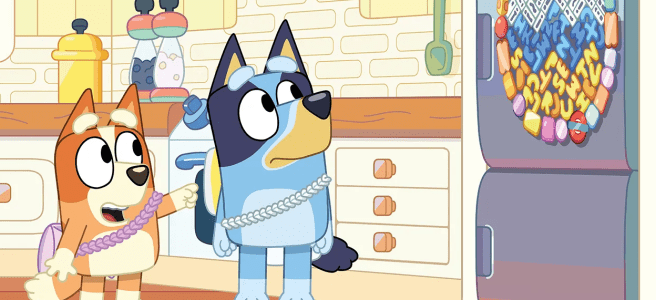
Image credit: Ludo Studios 2019

What was your favorite TV show when you were 5 or 6 years old? Did it essentially tell the same story over and over again? Just what was it about the show that kept you watching episode after episode? According to Kathryn VanArendonk, a critic who writes about TV, what makes Bluey the “best kids’ show of our time” is its refusal to take such a formulaic approach. Instead, Bluey’s unpredictability and quirky humor convince her that “these are real children,” ones she can learn grown-up lessons from. This review was first published in Vulture in 2021; this updated version was published on April 15, 2024, as Bluey’s popularity in the US reached a new peak.

Continue reading “How Bluey Became the Best Kids’ Show of Our Time”

I Feel So Ugly without My Makeup On

Image credit: Buse Koldas

Throughout history and in widely differing cultures around the world, people have used various kinds of makeup to mark or adorn themselves. Why? Answers to that question vary according to time and place, of course, but how about in our time and place: twenty-first century college campuses in the US? Enter Buse Koldas, a student from Istanbul who was in her first year at Johns Hopkins University, studying computer science and engineering, when she wrote about what makeup has meant to her for the Johns Hopkins News-Letter in 2024.

Continue reading “I Feel So Ugly without My Makeup On”

Astro Bot Review: All History Lessons Should Be This Fun

Image credit: Team Asobi

Think you’ve seen everything imaginable in video games? If so, you might want to read Harold Goldberg’s review of Sony’s Astro Bot. Goldberg speaks as an expert who has been playing, analyzing, and reviewing video games for over 15 years, most recently in this regular column for the New York Times that was launched in 2024. Let’s see if he intrigues you enough to give this game a try!

Continue reading “Astro Bot Review: All History Lessons Should Be This Fun”

Philip Gove and “Our Word”

Closeup view of a large dictionary viewed from the side. The book is open, and the yellowed edges of pages with thumb tabs are visible.

Image credit: Rosmarie Voegtli (rvoegtli/Flickr)

If we think about dictionaries at all, we mostly tend to think about them in a fairy tale way—that is, they simply appear, whole and complete, in the fullness of their power, delivered by some mythical being, probably one with wings. But where do dictionaries come from? Who writes them? What words are worthy of inclusion? Who knows? Their very authority defies questioning. But that’s silly, isn’t it? Of course humans make dictionaries, and it’s no small task. Like other grand human activities, dictionary-making involves a lot of debate, controversy, and passionate argument. In this November 2023 essay from American Scholar, writer, editor, and language scholar David Skinner shares a dictionary story that is, well, f*ckin’ epic.

Continue reading “Philip Gove and “Our Word””

Love It or Lose It: The Cycle

Photo of a brightly colored bird with a long beak perched on a branch. Superimposed on the image in large lower case letters are the words “love it or lose it”; beneath the words is the logo of the World Wildlife Fund, and below that, the URL wwf.org/love.

Birds are terrific, aren’t they? We like them. Some people even hang bird feeders in order to be able to see and hear birds more often. But then maybe those same people might unthinkingly kill the insects that the birds enjoy eating. Oops. In this short 2021 video, the World Wildlife Fund shows how all of nature is interconnected and comes around full circle to make one continuous chain of life.

Continue reading “Love It or Lose It: The Cycle”

That’s Not Actually True

A charcoal drawing with Kiese Laymon’s face in the center surrounded by four smaller images from the essay: a person behind a computer screen, Laymon in stocking feet sitting with a microphone, confederate soldiers doing lawn work, and a figure in stocking feet standing in a doorway behind a Welcome mat.

Image credit: Billy Dee

Today is Tuesday. That’s not actually true. Well, it might be. It depends. The truth is, well, complicated sometimes. Kiese Laymon, who describes himself as a “Black southern writer,” is an English professor and winner of several prestigious awards including the 2022 MacArthur Genius Grant. His novels and essays explore conditions of race, class, body image, and more. In this 2019 essay from Scalawag magazine, he deftly employs the refrain “that’s not actually true” to explore some of the jagged boundaries between experience and expectation, reality and perception, and history and possibility, all regions where everything gets tossed together in a jumble of contradictions. His conclusion makes clear, however, that what he is actually addressing are the effects of centuries of racism embodied in the inner life of a 21st century Black southern writer.

Continue reading “That’s Not Actually True”

Why So Many Baseball Players Are Dominican

Nine Dominican youth league players, in uniform, sitting in their dugout.

If you pay any attention to major league baseball (or even if you don’t), you’ve probably noticed that a disproportionately large number of star players are from the Dominican Republic, the Caribbean nation that shares its island with Haiti. Is that a coincidence? Are Dominicans just naturally and inexplicably gifted at the game of baseball? Well, no and (probably) no. The explanation involves much more than just sports; to get the full story, a Vox investigative team dug into two centuries of history and economics that involve, among other things, the Atlantic slave trade, the Cuban revolution, the business of baseball, and sugar. This video report was published in July 2023.

Continue reading “Why So Many Baseball Players Are Dominican”