All Praise to the Lunch Ladies

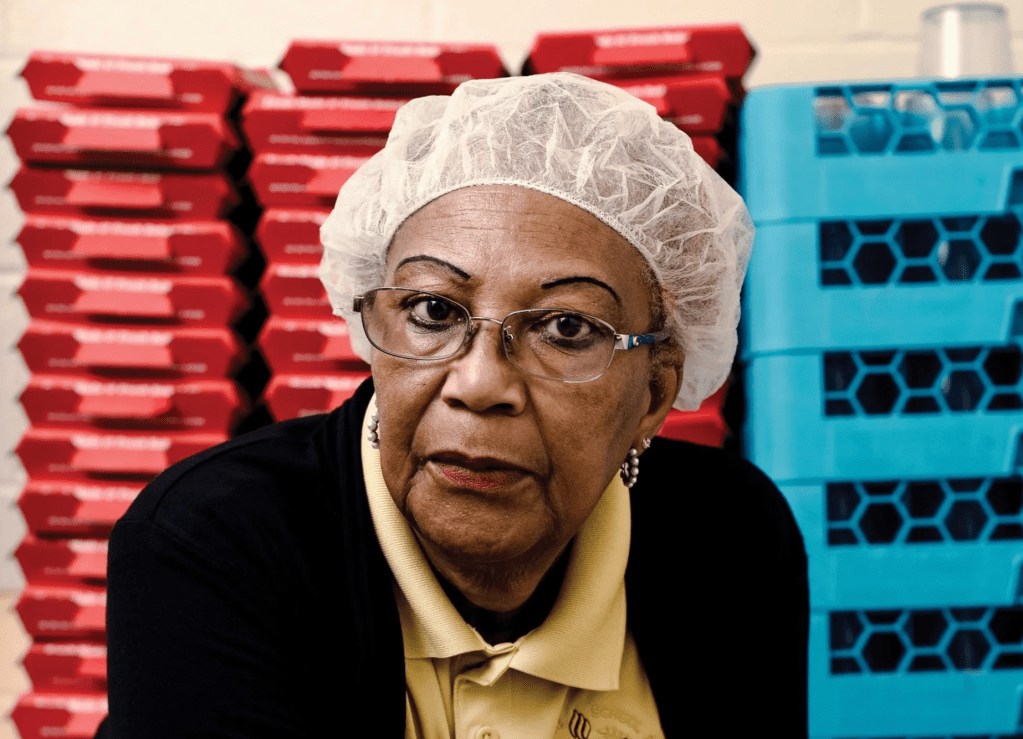
Image credit: Houston Cofield | The Bitter Southerner

Do you remember eating lunch in the school cafeteria? If so, did you have any favorite foods, and do you remember any of the ladies who worked in the lunch line? Maybe you’ve heard jokes about both the food and the “lunch ladies” who serve it (think Adam Sandler singing “yesterday’s meatloaf is today’s Sloppy Joes” in a song called “Lunch Lady Land”).  But have you ever stopped to think about what it takes to get the food for that meat loaf into the schools—and about what those women do to make sure that every student gets lunch? Jennifer Justus has. She’s a food writer whose grandmother worked in a school cafeteria, and she’s written this photo essay analyzing the politics and policies that make getting food to the schools so complicated and describing how lunch ladies ensure that no students go hungry—arguing that these women are in fact “heroes of the school lunch line.” This essay first appeared in 2025 in The Bitter Southerner, a media company that publishes stories, books, and photo essays about the American South.

Continue reading “All Praise to the Lunch Ladies”

Is 67 Just Brain Rot?

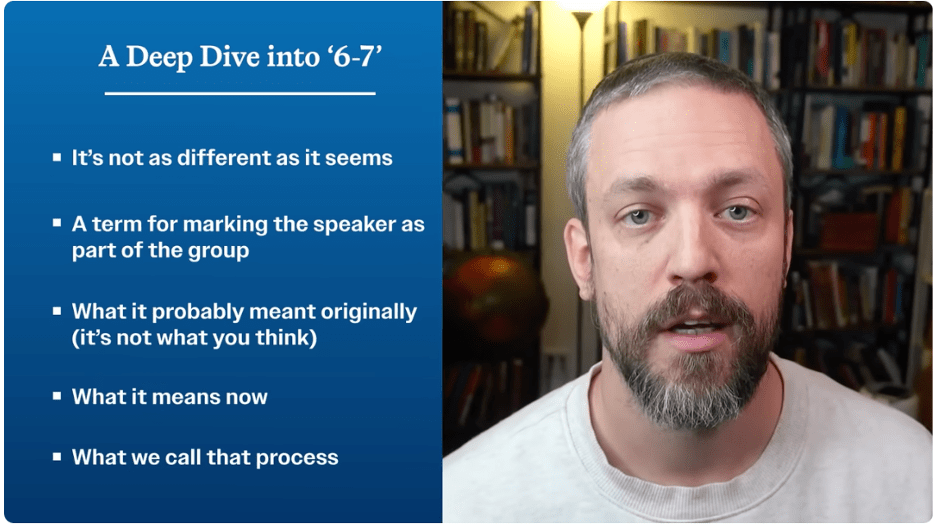
Image credit: languagejones | YouTube

What do you know about 67? It’s all overTikTok. Dictionary.com chose it as the 2025 Word of the Year. One preschool teacher told us it’s hard now to teach how to count to ten, that students all start shouting when they get to 6 and 7. So it’s popular slang, but do you have any idea what it means? According to some, it has no meaning—and some even call it brain rot. According to linguist Taylor Jones, however, “there’s actually a lot more to it.” In his 2025 video, linguist Taylor Jones traces the origins of 67 and complicates the impulse many “mature folks” have to dismiss its significance. Watch the video to learn how the mysterious origins of 67 is part of a larger pattern in the development of slang and the evolution of language.  

Continue reading “Is 67 Just Brain Rot?”

What I Learned as a Liberal Faculty Adviser for a Turning Point USA Chapter

Image credit: Ricardo Tomás | The New York Times

Imagine being asked to work with an organization whose goals you strongly oppose. That’s what happened to Nicholas Creel, a professor of business law at Georgia College & State University, when a student asked him to be the adviser for their college’s chapter of Turning Point USA. It was not something he would have thought to do, but his “dedication to the principles of free speech” led him to see it as a request he could not turn down. So, he said yes, “despite disagreeing with virtually every position the organization holds.” Read on to find out how it all turned out, in a 2025 piece he wrote for the New York Times. You may be surprised.  

Continue reading “What I Learned as a Liberal Faculty Adviser for a Turning Point USA Chapter”

A.I. Is Homogenizing Our Thoughts

Illustration credit: Ariel Davis | The New Yorker

“A vacuous and dangerous echo chamber.” “Best creative booster ever!”  “An existential threat to humanity.” Whether you love it or hate it—or fall somewhere in between—it’s likely that you have used generative AI yourself. But is it a good idea to be doing so? And what will be the consequences of that use? In this June 2025 piece from The New Yorker, staff writer Kyle Chayka, who covers technology and internet culture, reports on recent studies that offer potential answers to these questions! 

Continue reading “A.I. Is Homogenizing Our Thoughts”

How Country Music Turned the Ford F-150 Into a Luxury Ride

Image credit: Texas Monthly | Courtesy of Ford

Once upon a time, pickup trucks were strictly utility vehicles, used primarily for picking up and hauling stuff. Not so anymore, says Rose McMackin, a Texas writer whose work focuses on the American West. Nowadays, she says, pickup trucks are “aspirational,” used to project how the drivers want to be seen. So how on earth did that happen? According to McMackin, it’s a change that’s been largely fueled by country music. Read all about it (and listen to it) in an article she wrote for Texas Monthly  in August 2025. 

Continue reading “How Country Music Turned the Ford F-150 Into a Luxury Ride”

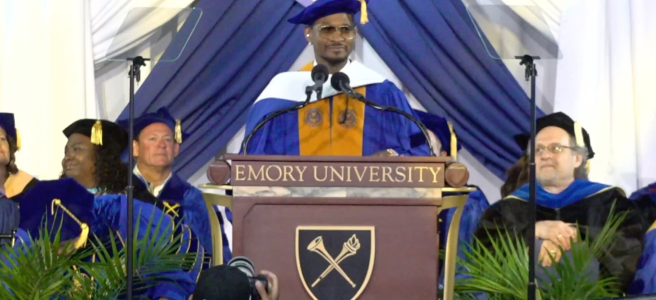
Did Usher Write His Own Commencement Speech? (Yeah!)

Image credit: Emory University

Have you ever had to make a presentation or give a speech that meant a lot to you, one in which you hoped to hit just the right note, make just the right connections, leave just the right impression? If so, you probably worked hard on it, revising over and over, getting advice, tweaking it right up to the last moment. Pretty much like Usher did for his 2025 commencement address at Emory University, though he had a publicist and team of professional advisers while you probably relied on friends or family members. In this New York Times article from May 2025, national correspondent Alan Blinder takes a close-up look at Usher’s speech composing process, trying to capture the recursive dynamic that drove Usher from start to finish. Here’s your chance to experience some of that process—and perhaps compare it to your own. 

Continue reading “Did Usher Write His Own Commencement Speech? (Yeah!)”

The Food Scientists Working to Change the Colors You Eat

Illustration credit: Nicholas Konrad | The New Yorker

Do you notice or pay attention to the color of the foods you eat? If not, it may be high time to think again, as changing or dropping such colors can apparently make once-relished foods seem “repulsive.” That’s one of the findings reported by Shayla Love in her August 2025 synthesis in The New Yorker of current food science research into viable substitutes for non-natural dyes, some of which may pose health hazards for consumers. Read Love’s report—and see if you feel differently about those oh-so-blue M&M’s. 

Continue reading “The Food Scientists Working to Change the Colors You Eat”

I Feel So Ugly without My Makeup On

Image credit: Buse Koldas

Throughout history and in widely differing cultures around the world, people have used various kinds of makeup to mark or adorn themselves. Why? Answers to that question vary according to time and place, of course, but how about in our time and place: twenty-first century college campuses in the US? Enter Buse Koldas, a student from Istanbul who was in her first year at Johns Hopkins University, studying computer science and engineering, when she wrote about what makeup has meant to her for the Johns Hopkins News-Letter in 2024.

Continue reading “I Feel So Ugly without My Makeup On”