
The History of American Landscape Painting Is Not Pretty

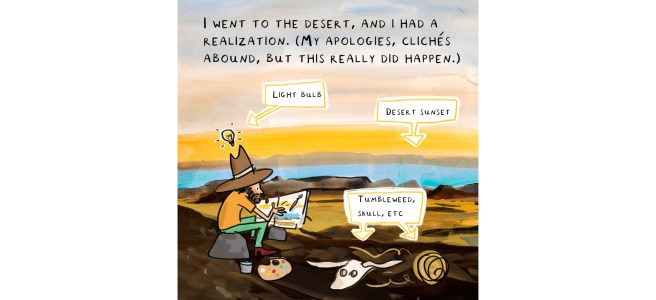
The first panel of a graphic essay shows the artist sitting on a rock in the desert. The text written across the sky says “I went to the desert, and I had a realization. (My apologies, clichés abound, but this really did happen.)” Elements of the image are labeled “light bulb,” “desert sunset,” and “tumbleweed, skull, etc.”

Image credit: Hyperallergic

Have you given any thought this week to landscape painting? No? To be honest, neither have we. But Steven Weinberg, a New York-based artist, children’s book author, and B&B owner, is passionate about landscape painting and its importance to both history and environmentalism. He explains it all in this November 2022 graphic essay on Hyperallergic, an online magazine. (Please note: a little background in US history will be very helpful to you here. We suggest you look up the names he mentions, but we’ll give you a little head start on one important concept. “Manifest destiny” was a 19th century belief that supported and justified the westward expansion of US territories and settlement by people of European descent at the expense of the native people who already occupied and made their homes on those lands.)

Continue reading “The History of American Landscape Painting Is Not Pretty”

Nobel Prize Lecture 2021

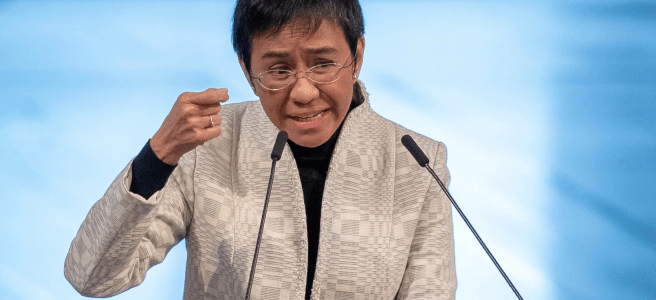
Maria Ressa is delivering her Nobel Prize Lecture and making an emphatic gesture.

Image credit: Rappler

Maria Ressa, in her 2021 Nobel Peace Prize lecture, states it bluntly and succinctly: “Without facts, you can’t have truth. Without truth, you can’t have trust. Without trust, we have no shared reality, no democracy.” Ressa has a rare ability to acknowledge and expose the horrors of the world and still inspire optimism; her address is a call to action, a call to conscience. We’ve excerpted it for you here. You can also read a transcript/translation of her complete speech on these sites: Rappler.com (in English or Filipino) or NobelPrize.org (in English, Russian, or Norwegian). 

Continue reading “Nobel Prize Lecture 2021”

How to Fix Social Media

An open laptop leans against an old-style radio atop a table.

Social media, what a hot mess! Still, hard to imagine the world these days without them. They’re immensely useful in so many ways, and in just as many ways, they can be tremendously harmful. What can we—as individuals and as a society—do to reduce the damage that social media can cause while boosting their helpfulness? Best-selling author Nicholas Carr, whose work focuses on technology, economics, and culture, details his plan for resolving major social media problems in this Fall 2021 essay from the New Atlantis.

Continue reading “How to Fix Social Media”

Don’t Look Away: Photojournalists Are Documenting the Brutality of Russia’s War in Ukraine

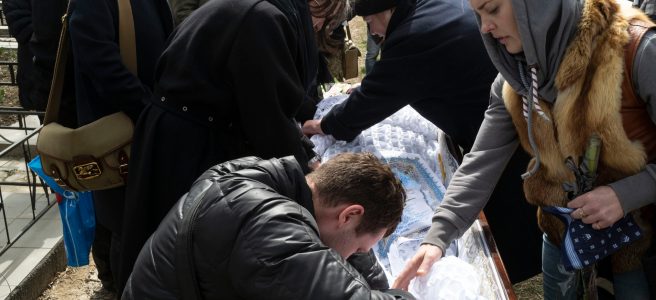
A man and woman grieve over the casket of Andrii Tanulin, a victim of the bombing in Ukraine. They are accompanied by several other mourners.

War photographers’ jobs are more than just dangerous; they require deep sensitivity to the traumas of war to all of the people immediately affected. They must act quickly and decisively to position themselves and choose their shots. Editors and publishers don’t face the immediate danger, of course, but their decisions about which photos to include for their audiences requires plenty of delicacy and judgment. In this April 2022 Nieman Labs essay, Chloe Coleman, photo editor for the Washington Post, explains how images for publication are chosen, what factors are considered in the decision, and what, ultimately, is the goal of presenting such images to the general public.

Continue reading “Don’t Look Away: Photojournalists Are Documenting the Brutality of Russia’s War in Ukraine”

How Place Names Impact the Way We See Landscape

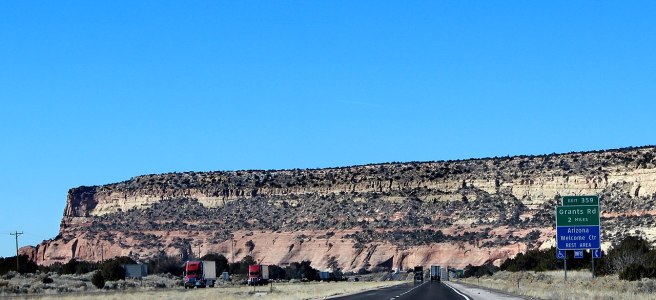
A highway in Arizona leads to a large, rocky cliffside. The signs on the highway read: "Exit 359, Grants Rd, 2 miles," and "Arizona Welcome Center Rest Area."

Image credit: Lupton, AZ. MARELBU, Creative Commons License

When we look at a familiar landscape, we automatically associate its features with the names that we’ve learned for them. What do those names mean? Are they personally meaningful to you? In this May 2022 essay from High Country News, Brian Oaster (they/them), investigative journalist and member of Choctaw Nation, argues that restoring meaningful Indigenous place names would carry a benefit for non-Natives and Native alike.

Continue reading “How Place Names Impact the Way We See Landscape”

The “Great Resignation” Is Finally Getting Companies to Take Burnout Seriously. Is It Enough?

An illustration of a man sitting at a desk looking at a computer monitor surrounded by tally marks.

They’re calling it the Great Resignation, and it’s all over the news these days. So many people quitting their jobs! What’s going on?! Pundits and analysts are looking from every angle, trying to get a handle on what may (or may not) be a huge trend here in the US at the end of 2021. In this October 2021 article, Time Magazine’s health correspondent Jamie Ducharme analyzes the situation, focusing on worker burnout, and offers suggestions for workers and their employers.

Continue reading “The “Great Resignation” Is Finally Getting Companies to Take Burnout Seriously. Is It Enough?”