
AI, Ain’t I A Woman?

Image credit: Joy Buolamwini

Can artificial intelligence technology guess the gender of Oprah, Serena, Michelle, and other iconic women? That’s the question Canadian computer scientist and founder of the Algorithmic Justice League Joy Buolamwini poses in this three-and-a-half minute YouTube video.  Before you watch the video, what do you think the answer will be, especially given that the three women Buolamwini mentions are so well known that she can omit their last names? Now click “play.” 

Continue reading “AI, Ain’t I A Woman?”

Did Usher Write His Own Commencement Speech? (Yeah!)

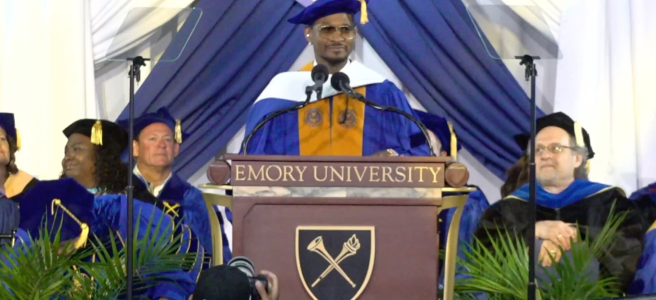
Image credit: Emory University

Have you ever had to make a presentation or give a speech that meant a lot to you, one in which you hoped to hit just the right note, make just the right connections, leave just the right impression? If so, you probably worked hard on it, revising over and over, getting advice, tweaking it right up to the last moment. Pretty much like Usher did for his 2025 commencement address at Emory University, though he had a publicist and team of professional advisers while you probably relied on friends or family members. In this New York Times article from May 2025, national correspondent Alan Blinder takes a close-up look at Usher’s speech composing process, trying to capture the recursive dynamic that drove Usher from start to finish. Here’s your chance to experience some of that process—and perhaps compare it to your own. 

Continue reading “Did Usher Write His Own Commencement Speech? (Yeah!)”

A Cartoon: You Guys….

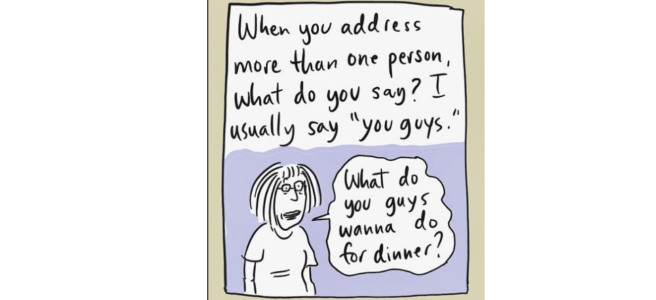
Image credit: Roz Chast, Instagram

Hey, you guys! Is this an expression you might use to address more than one person? If so, see what cartoonist Roz Chast has to say about that in this cartoon posted on Instagram in November, 2024. Chast is an award-winning cartoonist who is also a fellow of the American Philosophical Society. A philosophical cartoonist? A cartoonist philosopher? You decide!

Continue reading “A Cartoon: You Guys….”

This Full Page Ad Was Written Entirely in Chicken

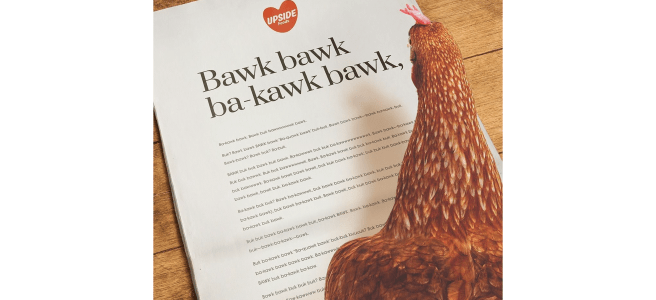
A red chicken stands on a printed page as if reading it; the title on the page, in large letters, is “Bawk bawk ba-kawk bawk.”

Do chickens talk? What a silly question! Of course they do; ask any child. So maybe we shouldn’t be surprised to learn that they can read as well. We have the evidence right here: a letter composed in chicken language, signed by the Founder and CEO of Upside Foods (a human), and addressed to all chickens. The letter appeared as a full-page ad in the New York Times in November 2022 (really!). Advertising journalist Tim Nudd gives a full report on it for Muse by Clio, an advertising industry periodical.

Continue reading “This Full Page Ad Was Written Entirely in Chicken”

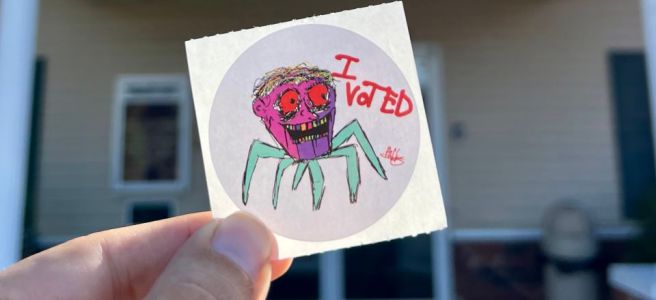
Yes, This New York County Actually Used the Crazy Spider Voting Sticker Design That You Saw Online

A round “I voted” sticker shows a childish drawing of a green-legged spider figure with a smiling human head. The face is in shades of purple with big red eyes and multicolor teeth.

Image credit: CNN

News giant CNN publishes a detailed report about an “I voted” sticker that is being distributed in a medium-sized county in New York. Wait. This is newsworthy?! Really? “I voted” stickers are usually the most yawn-inducing bits of civic display imaginable. Well, not this time, and not in Ulster County, New York, where the winning entry in a county-wide contest shows a childish drawing of a brightly colored monster with insect legs and a scary human face that says “I voted.” CNN reporter Zoe Sottile filed this report in November 2022.

Continue reading “Yes, This New York County Actually Used the Crazy Spider Voting Sticker Design That You Saw Online”

How and Why Do Consumers Access News on Social Media?

Two cell phones side by side, one showing a screen grab from the Guardian’s “Fake or for Real” feature, the other showing a screen grab of a Washington Post TikTok.

Image credit: Reuters Institute

It’s not news that fewer people than ever get their news from newspapers. Many people, particularly younger ones, use social media to stay informed of events. But how many people? Who are they? Which platforms do they use? And why have these become the sources of choice? Good questions, right? Political science professor Simge Andı researched them extensively; her detailed report was published in June 2021 by Reuters Institute for the Study of Journalism.

Continue reading “How and Why Do Consumers Access News on Social Media?”

Baldo Cartoon: Text Punctuation

Cartoon in which a young man is appalled that his father uses a period in a text message; the young man’s companion agrees.

Have you noticed that texting styles vary a lot between generations? [Insert eyeroll emoji.] Silly question. Of course you have. There are many cultural factors that contribute to style variation in texting, and age/generation is certainly one of them. When you notice it, is it amusing? Annoying? Endearing? In this August 2021 Baldo cartoon strip, the youthful main character reacts with horror to a text from his dad. Hector D. Cantú and Carlos Castellanos’ strip has appeared in numerous daily newspapers in the US for more than 20 years. Its humor is principally centered around family life, and like many other daily strips, the characters never age.

Continue reading “Baldo Cartoon: Text Punctuation”

The History of American Landscape Painting Is Not Pretty

The first panel of a graphic essay shows the artist sitting on a rock in the desert. The text written across the sky says “I went to the desert, and I had a realization. (My apologies, clichés abound, but this really did happen.)” Elements of the image are labeled “light bulb,” “desert sunset,” and “tumbleweed, skull, etc.”

Image credit: Hyperallergic

Have you given any thought this week to landscape painting? No? To be honest, neither have we. But Steven Weinberg, a New York-based artist, children’s book author, and B&B owner, is passionate about landscape painting and its importance to both history and environmentalism. He explains it all in this November 2022 graphic essay on Hyperallergic, an online magazine. (Please note: a little background in US history will be very helpful to you here. We suggest you look up the names he mentions, but we’ll give you a little head start on one important concept. “Manifest destiny” was a 19th century belief that supported and justified the westward expansion of US territories and settlement by people of European descent at the expense of the native people who already occupied and made their homes on those lands.)

Continue reading “The History of American Landscape Painting Is Not Pretty”