A.I. Is Homogenizing Our Thoughts

Illustration credit: Ariel Davis | The New Yorker

“A vacuous and dangerous echo chamber.” “Best creative booster ever!”  “An existential threat to humanity.” Whether you love it or hate it—or fall somewhere in between—it’s likely that you have used generative AI yourself. But is it a good idea to be doing so? And what will be the consequences of that use? In this June 2025 piece from The New Yorker, staff writer Kyle Chayka, who covers technology and internet culture, reports on recent studies that offer potential answers to these questions! 

Continue reading “A.I. Is Homogenizing Our Thoughts”

How Country Music Turned the Ford F-150 Into a Luxury Ride

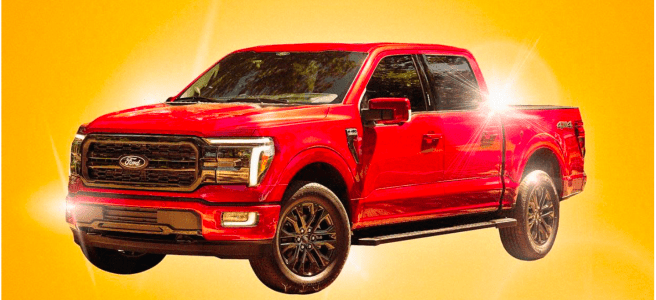
Image credit: Texas Monthly | Courtesy of Ford

Once upon a time, pickup trucks were strictly utility vehicles, used primarily for picking up and hauling stuff. Not so anymore, says Rose McMackin, a Texas writer whose work focuses on the American West. Nowadays, she says, pickup trucks are “aspirational,” used to project how the drivers want to be seen. So how on earth did that happen? According to McMackin, it’s a change that’s been largely fueled by country music. Read all about it (and listen to it) in an article she wrote for Texas Monthly  in August 2025. 

Continue reading “How Country Music Turned the Ford F-150 Into a Luxury Ride”

A Cartoon: You Guys….

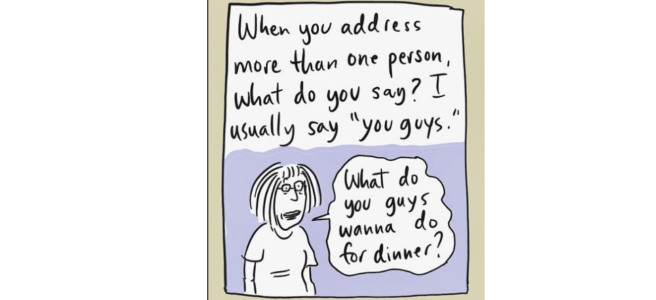
Image credit: Roz Chast, Instagram

Hey, you guys! Is this an expression you might use to address more than one person? If so, see what cartoonist Roz Chast has to say about that in this cartoon posted on Instagram in November, 2024. Chast is an award-winning cartoonist who is also a fellow of the American Philosophical Society. A philosophical cartoonist? A cartoonist philosopher? You decide!

Continue reading “A Cartoon: You Guys….”

Philip Gove and “Our Word”

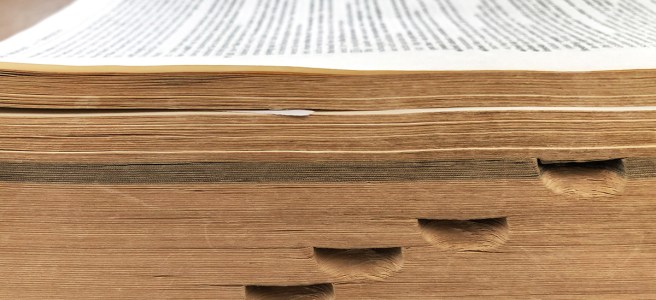
Closeup view of a large dictionary viewed from the side. The book is open, and the yellowed edges of pages with thumb tabs are visible.

Image credit: Rosmarie Voegtli (rvoegtli/Flickr)

If we think about dictionaries at all, we mostly tend to think about them in a fairy tale way—that is, they simply appear, whole and complete, in the fullness of their power, delivered by some mythical being, probably one with wings. But where do dictionaries come from? Who writes them? What words are worthy of inclusion? Who knows? Their very authority defies questioning. But that’s silly, isn’t it? Of course humans make dictionaries, and it’s no small task. Like other grand human activities, dictionary-making involves a lot of debate, controversy, and passionate argument. In this November 2023 essay from American Scholar, writer, editor, and language scholar David Skinner shares a dictionary story that is, well, f*ckin’ epic.

Continue reading “Philip Gove and “Our Word””

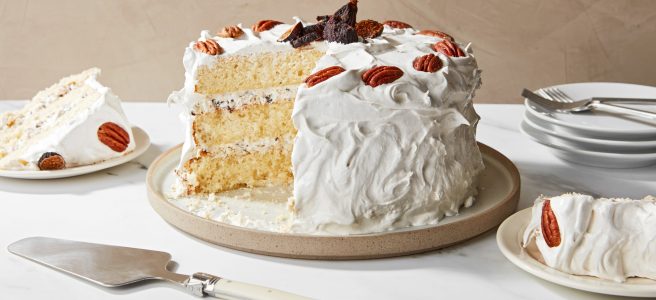
Why Are So Many Cakes Named After Fabric?

In the center of a white table is a 3-layer yellow cake on a rimmed plate, with thick white frosting spread with peaks. The top of the cake is ringed with pecan halves, and several ripe figs adorn the center. Two slices cut from the cake are on plates on the table, along with a few more plates, forks, and a cake server.

Image credit: Photo by Joseph De Leo, Food Styling by Erika Joyce

Red velvet, black satin, lemon chiffon. We could be talking about fashion here, but we’re not. We’re talking about cake. It turns out (you likely have never noticed) that many classic cakes in the US take their names from fabrics. Curious, right? But once you read the analysis and explanation of food writer and chef Brandon Summers-Miller in this June 2022 Epicurious article, it will all start making sense (and make you hungry, as well).

Continue reading “Why Are So Many Cakes Named After Fabric?”

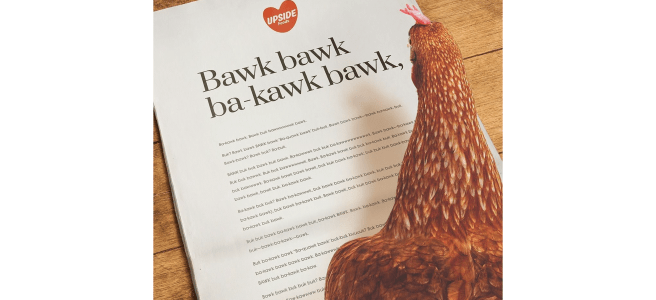
This Full Page Ad Was Written Entirely in Chicken

A red chicken stands on a printed page as if reading it; the title on the page, in large letters, is “Bawk bawk ba-kawk bawk.”

Do chickens talk? What a silly question! Of course they do; ask any child. So maybe we shouldn’t be surprised to learn that they can read as well. We have the evidence right here: a letter composed in chicken language, signed by the Founder and CEO of Upside Foods (a human), and addressed to all chickens. The letter appeared as a full-page ad in the New York Times in November 2022 (really!). Advertising journalist Tim Nudd gives a full report on it for Muse by Clio, an advertising industry periodical.

Continue reading “This Full Page Ad Was Written Entirely in Chicken”

Why Are All Action Heroes Named Jack, James, or John?

A collage of action heroes Capt. James T. Kirk, Johnny Utah, James Bond, John Wick, Jack Ryan, Jason Bourne, and John James Rambo.

Image credit: Photo illustration by Natalie Matthews-Ramo/Slate. Photos by David Lee/Lionsgate, MGM, Amazon Prime Video, NBC, Universal, Twentieth Century Fox, and Yoni S. Hamenahem/Wikipedia.

“Bond. James Bond.” Such a recognizable movie quote even though it has no punchline, makes no clever point. Does it matter that his name is James and not, say, Clive (very English!) or Butch (very strong and also alliterative)? Such a silly question. But of course it matters; at least, his name follows a definite pattern of action hero names. Demetria Glace, data researcher and author, investigates a pattern she has observed in the names of action heroes in this March 2023 report in Slate.

Continue reading “Why Are All Action Heroes Named Jack, James, or John?”

Baldo Cartoon: Text Punctuation

Cartoon in which a young man is appalled that his father uses a period in a text message; the young man’s companion agrees.

Have you noticed that texting styles vary a lot between generations? [Insert eyeroll emoji.] Silly question. Of course you have. There are many cultural factors that contribute to style variation in texting, and age/generation is certainly one of them. When you notice it, is it amusing? Annoying? Endearing? In this August 2021 Baldo cartoon strip, the youthful main character reacts with horror to a text from his dad. Hector D. Cantú and Carlos Castellanos’ strip has appeared in numerous daily newspapers in the US for more than 20 years. Its humor is principally centered around family life, and like many other daily strips, the characters never age.

Continue reading “Baldo Cartoon: Text Punctuation”