That’s Not Actually True

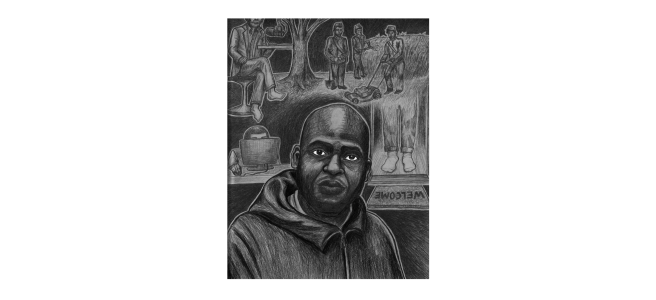
A charcoal drawing with Kiese Laymon’s face in the center surrounded by four smaller images from the essay: a person behind a computer screen, Laymon in stocking feet sitting with a microphone, confederate soldiers doing lawn work, and a figure in stocking feet standing in a doorway behind a Welcome mat.

Image credit: Billy Dee

Today is Tuesday. That’s not actually true. Well, it might be. It depends. The truth is, well, complicated sometimes. Kiese Laymon, who describes himself as a “Black southern writer,” is an English professor and winner of several prestigious awards including the 2022 MacArthur Genius Grant. His novels and essays explore conditions of race, class, body image, and more. In this 2019 essay from Scalawag magazine, he deftly employs the refrain “that’s not actually true” to explore some of the jagged boundaries between experience and expectation, reality and perception, and history and possibility, all regions where everything gets tossed together in a jumble of contradictions. His conclusion makes clear, however, that what he is actually addressing are the effects of centuries of racism embodied in the inner life of a 21st century Black southern writer.

Continue reading “That’s Not Actually True”
Natural Magic

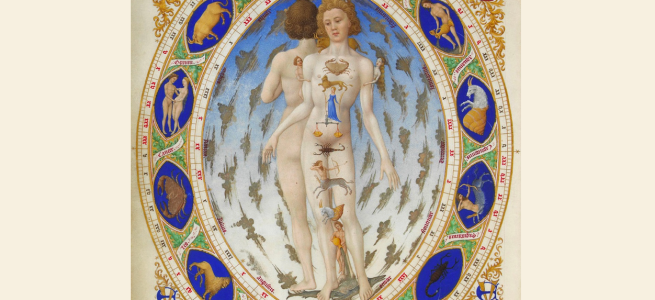
A medieval-style painting of two nude figures, one facing forward and one facing backward, circled by an oval-shaped zodiac calendar.

Modern medicine is magic. Do we mean that literally or metaphorically? Well, yes and yes. For example, a key ingredient in some chemotherapy formulas for cancer—yew—was also an ingredient in the witches’ brew described in Shakespeare’s Macbeth along with “eye of newt and toe of frog.” Yew’s potent and unusual properties have been known to healers and wizards for centuries. Writing professor and author Ellen Wayland-Smith explores the medicine/magic connection more deeply while discussing her own cancer treatment in this March 2021 essay from American Scholar.

Continue reading “Natural Magic”

How We Tell Stories in Texas

Shape of Texas on a red background, superimposed with various historical documents related to the state.

What do you remember learning in school about the history of your town or state? Did it give you a sense of pride? Now that you’re older and wiser, have you discovered anything that was left out (but probably shouldn’t have been)? In this July 2021 essay in Bitter Southerner, freelance writer and Texas native Sarah Enelow-Snyder writes about her exciting seventh grade field trip to the Alamo in San Antonio along with her critique of the ways that history is (and isn’t) taught in school.

Continue reading “How We Tell Stories in Texas”

What It Means to Be From Two Places at Once

A surfer wearing a red "Vans" shirt rides a wave.

If you were selected to compete in the Olympics, what country would you represent? For many athletes, the question would never even come up, but that’s not true for everyone. Mahina Maeda, Hawaiian born and raised, participated in the first-ever Olympic surfing competition, representing Japan. In this July 2021 essay in the Players’ Tribune, she explains that she is “more than one flag, one country, one language.” (You can click the link at the top of her essay to read it in Japanese.)

Continue reading “What It Means to Be From Two Places at Once”

G Is for Gabi

A child lies on a bed reading a Fodor's guidebook to Washington, DC.

When his family moved from one country to another, a boy’s whole relationship to his name changed. We bet that wasn’t the consequence you expected to read after the dramatic first part of that sentence, but think about it: we carry a lot of drama in our names. Johns Hopkins University student Gabriel Lesser was that boy; read his account in this April 2021 narrative in the university’s News-Letter

Continue reading “G Is for Gabi”

How Covid-19 Gave Me Back My Southern Accent

A drawing of a set of dentures wearing a cowboy hat and cowboy boots.

We already know all about how the world around us changed in 2020, how we had to modify, adjust, and adapt along with it. We’ve read and discussed all the effects, all the angles; we know all about it. One major aspect of life, though, may have gone unexamined: language habits. Journalist and culture critic Tracy Moore is surprised to notice a change in her own speech, and she relates her experience with it in this March 2021 Washington Post essay.

Continue reading “How Covid-19 Gave Me Back My Southern Accent”

Eulogy for Kobe Bryant (excerpt)

NBA hall-of-famer Michael Jordan speaking on MSNBC.

Michael Jordan is a former superstar basketball player who dominated the NBA for more than a decade until his final retirement in 2003, but you probably already know that, even if you’re not a fan. You likely also know that Kobe Bryant was a superstar basketball player for the Los Angeles Lakers who died at age 42 in a helicopter crash. Here is an excerpt from Jordan’s eulogy at a memorial service for Bryant held at the Staples Center, the Lakers’ home arena, on February 24, 2020.

Continue reading “Eulogy for Kobe Bryant (excerpt)”

Manoomin: Food that Grows on the Water

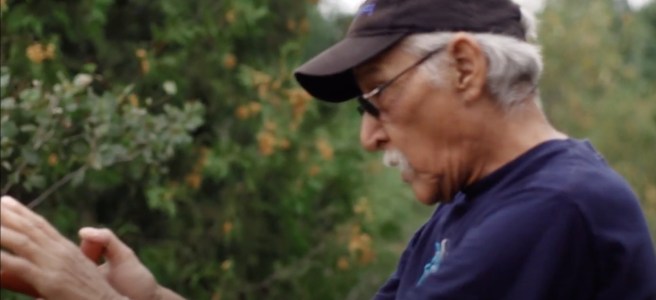
The side profile of an older gentleman wearing a hat and sunglasses and trimming a bush.

In English, it’s called “wild rice”; in the languages spoken by Anishinaabe people, a culturally related group that includes the Ojibwe, Chippewa, and other indigenous peoples, the food is called “manoomin.” (If you listen carefully, you’ll be able to pick out the word “Anishinaabe” in the invocation/prayer spoken at the beginning of the video.) This manoomin has tremendous importance to the Anishinaabe people, not only for its high nutritional value, but also for its cultural significance. 21st century technology and socio-political conditions in the Anishinaabe region are encroaching on the relationship between manoomin and the people who rely on it for material and spiritual sustenance. In this video, Fred Ackley Jr. of the Sokaogon Chippewa Community describes the gathering of manoomin and explains its significance; the video was produced in February 2020 by PBS Wisconsin Education.

Continue reading “Manoomin: Food that Grows on the Water”