The Food Scientists Working to Change the Colors You Eat

Illustration credit: Nicholas Konrad | The New Yorker

Do you notice or pay attention to the color of the foods you eat? If not, it may be high time to think again, as changing or dropping such colors can apparently make once-relished foods seem “repulsive.” That’s one of the findings reported by Shayla Love in her August 2025 synthesis in The New Yorker of current food science research into viable substitutes for non-natural dyes, some of which may pose health hazards for consumers. Read Love’s report—and see if you feel differently about those oh-so-blue M&M’s. 

Continue reading “The Food Scientists Working to Change the Colors You Eat”

A Guerilla Gardener in South Central LA

Image credit: TED

How would you feel if you had no way of getting healthy food? Not good, right? That was the situation in South Central Los Angeles, one that Ron Finley set out to correct. He started by planting a vegetable garden on a strip of land between his house and the street. His 2013 TED Talk describes what happened after that.

Continue reading “A Guerilla Gardener in South Central LA”

Love It or Lose It: The Cycle

Photo of a brightly colored bird with a long beak perched on a branch. Superimposed on the image in large lower case letters are the words “love it or lose it”; beneath the words is the logo of the World Wildlife Fund, and below that, the URL wwf.org/love.

Birds are terrific, aren’t they? We like them. Some people even hang bird feeders in order to be able to see and hear birds more often. But then maybe those same people might unthinkingly kill the insects that the birds enjoy eating. Oops. In this short 2021 video, the World Wildlife Fund shows how all of nature is interconnected and comes around full circle to make one continuous chain of life.

Continue reading “Love It or Lose It: The Cycle”

The Ocean Cleanup — “How System 002 Works”

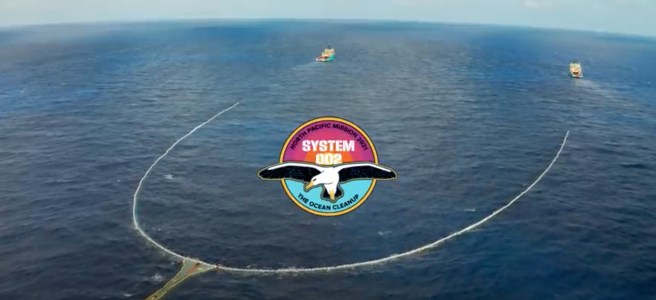
Ocean and horizon with long view of Ocean Cleanup’s System 002 with its two vessels, long net, and retention zone.

Image credit: The Ocean Cleanup

Have you heard of the Great Pacific Garbage Patch? No, it’s not something from Sesame Street (although it sounds like it could be). It’s big, it’s in the middle of the ocean, it’s garbage-y. And it’s real. Ocean Cleanup is an organization that uses innovative techniques to clean up the patch. In addition to their website, they have numerous YouTube videos that explain their techniques and their progress. For our Library, we’ve chosen this short one from October 2021.

Continue reading “The Ocean Cleanup — “How System 002 Works””

Surprising Creatures Lurk in the Great Pacific Garbage Patch

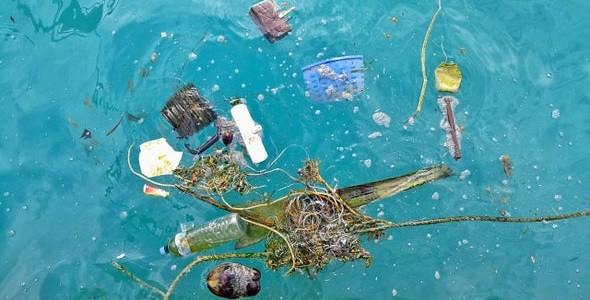
Assorted plastics and other debris float on the surface of the sea.

Image credit: Jakchai Tilakoon/EyeEm/Getty Images

Raise your hand if you think that the tons and tons of plastic garbage floating in the Pacific Ocean are a good thing, something to be preserved and protected. Nobody? No hands up? Good. We all know that it’s ugly and harmful to wildlife; there’s no controversy there. Now, new research shows that it’s even worse than we imagined. Scientific American science writer Meghan Bartels describes a newly researched threat posed by the Great Pacific Garbage Patch in this April 2023 report.

Continue reading “Surprising Creatures Lurk in the Great Pacific Garbage Patch”

The Thinking Error That Makes People Susceptible to Climate Change Denial

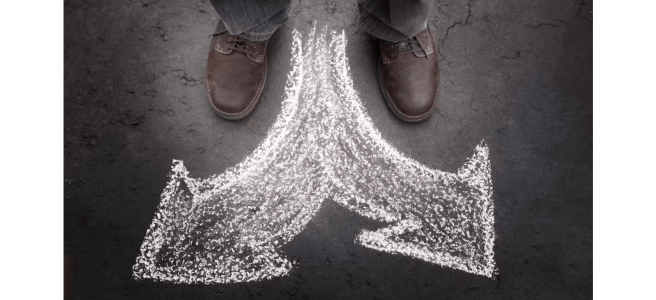
Photo from above of a person standing before a chalked arrow that points both to the left and to the right.

Image credit: eyetoeyePIX via Getty Images

We’ve all seen and heard scientific reports and arguments about climate change from scholars in many different disciplines—biology, geology, environmental sciences, chemistry, and many more, and those disciplines seem obviously relevant to the phenomenon. Here’s one from psychology. What does psychology have to do with climate change? Not much with the changes themselves, perhaps, but it may have a lot to do with the debates and controversies surrounding the issue. In this May 2023 essay in The Conversation, psychology professor Jeremy P. Shapiro proposes an explanation for climate change denial.

Continue reading “The Thinking Error That Makes People Susceptible to Climate Change Denial”

The History of American Landscape Painting Is Not Pretty

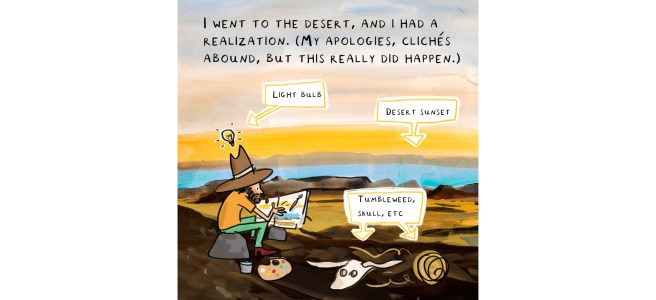
The first panel of a graphic essay shows the artist sitting on a rock in the desert. The text written across the sky says “I went to the desert, and I had a realization. (My apologies, clichés abound, but this really did happen.)” Elements of the image are labeled “light bulb,” “desert sunset,” and “tumbleweed, skull, etc.”

Image credit: Hyperallergic

Have you given any thought this week to landscape painting? No? To be honest, neither have we. But Steven Weinberg, a New York-based artist, children’s book author, and B&B owner, is passionate about landscape painting and its importance to both history and environmentalism. He explains it all in this November 2022 graphic essay on Hyperallergic, an online magazine. (Please note: a little background in US history will be very helpful to you here. We suggest you look up the names he mentions, but we’ll give you a little head start on one important concept. “Manifest destiny” was a 19th century belief that supported and justified the westward expansion of US territories and settlement by people of European descent at the expense of the native people who already occupied and made their homes on those lands.)

Continue reading “The History of American Landscape Painting Is Not Pretty”

Natural Magic

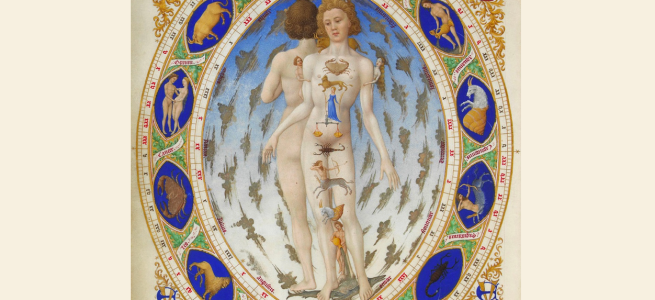
A medieval-style painting of two nude figures, one facing forward and one facing backward, circled by an oval-shaped zodiac calendar.

Modern medicine is magic. Do we mean that literally or metaphorically? Well, yes and yes. For example, a key ingredient in some chemotherapy formulas for cancer—yew—was also an ingredient in the witches’ brew described in Shakespeare’s Macbeth along with “eye of newt and toe of frog.” Yew’s potent and unusual properties have been known to healers and wizards for centuries. Writing professor and author Ellen Wayland-Smith explores the medicine/magic connection more deeply while discussing her own cancer treatment in this March 2021 essay from American Scholar.

Continue reading “Natural Magic”