A.I. Is Homogenizing Our Thoughts

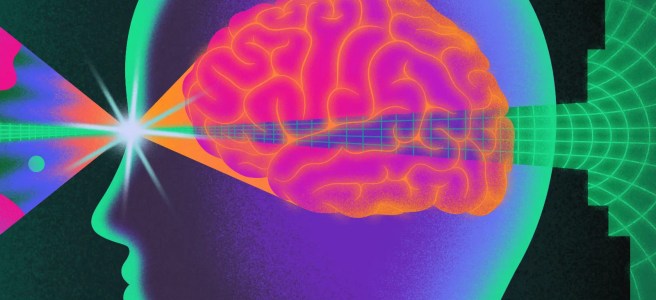
Illustration credit: Ariel Davis | The New Yorker

“A vacuous and dangerous echo chamber.” “Best creative booster ever!”  “An existential threat to humanity.” Whether you love it or hate it—or fall somewhere in between—it’s likely that you have used generative AI yourself. But is it a good idea to be doing so? And what will be the consequences of that use? In this June 2025 piece from The New Yorker, staff writer Kyle Chayka, who covers technology and internet culture, reports on recent studies that offer potential answers to these questions! 

Continue reading “A.I. Is Homogenizing Our Thoughts”

The Food Scientists Working to Change the Colors You Eat

Illustration credit: Nicholas Konrad | The New Yorker

Do you notice or pay attention to the color of the foods you eat? If not, it may be high time to think again, as changing or dropping such colors can apparently make once-relished foods seem “repulsive.” That’s one of the findings reported by Shayla Love in her August 2025 synthesis in The New Yorker of current food science research into viable substitutes for non-natural dyes, some of which may pose health hazards for consumers. Read Love’s report—and see if you feel differently about those oh-so-blue M&M’s. 

Continue reading “The Food Scientists Working to Change the Colors You Eat”

Philip Gove and “Our Word”

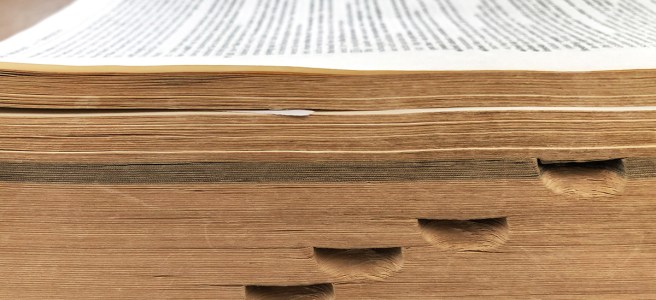
Closeup view of a large dictionary viewed from the side. The book is open, and the yellowed edges of pages with thumb tabs are visible.

Image credit: Rosmarie Voegtli (rvoegtli/Flickr)

If we think about dictionaries at all, we mostly tend to think about them in a fairy tale way—that is, they simply appear, whole and complete, in the fullness of their power, delivered by some mythical being, probably one with wings. But where do dictionaries come from? Who writes them? What words are worthy of inclusion? Who knows? Their very authority defies questioning. But that’s silly, isn’t it? Of course humans make dictionaries, and it’s no small task. Like other grand human activities, dictionary-making involves a lot of debate, controversy, and passionate argument. In this November 2023 essay from American Scholar, writer, editor, and language scholar David Skinner shares a dictionary story that is, well, f*ckin’ epic.

Continue reading “Philip Gove and “Our Word””

The Washington Post Takes the “Unusual Step” of Publishing Graphic Photos from Mass Shootings

A flat, grassy field lined with rows of simple grave markers that form a geometric pattern; the Washington Monument stands in the background.

Image credit: Joe Flood

It’s not news to any of us that mass murders are alarmingly common here in the US. Most of us can rattle off place names—Sandy Hook, Uvalde, Parkland, Las Vegas, and numerous others. Many of us can name shooters, and sometimes we remember the names of the people whose lives were so senselessly ended. But those are names and words; what about images? For many good reasons, news organizations seldom publish photos or video of the grisly scenes. In November 2023, however, the Washington Post, a large-circulation daily newspaper, published mass shooting photos and interview snippets in a report titled “Terror on Repeat: A rare look at the devastation caused by AR-15 shootings.” The Post’s report was so unprecedented that Nieman Lab, a journalism watchdog and research organization affiliated with Harvard University, documented the process that the Post followed in a November 2023 report written by Nieman Lab’s deputy editor, Sarah Scire.

Continue reading “The Washington Post Takes the “Unusual Step” of Publishing Graphic Photos from Mass Shootings”

This Full Page Ad Was Written Entirely in Chicken

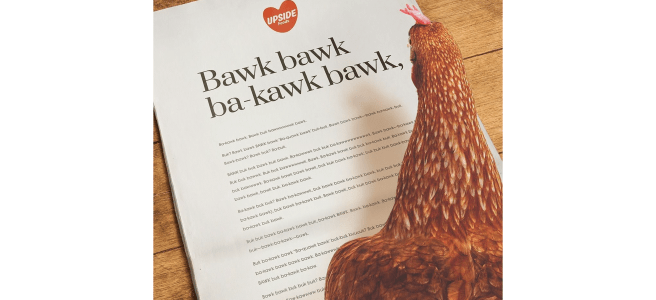
A red chicken stands on a printed page as if reading it; the title on the page, in large letters, is “Bawk bawk ba-kawk bawk.”

Do chickens talk? What a silly question! Of course they do; ask any child. So maybe we shouldn’t be surprised to learn that they can read as well. We have the evidence right here: a letter composed in chicken language, signed by the Founder and CEO of Upside Foods (a human), and addressed to all chickens. The letter appeared as a full-page ad in the New York Times in November 2022 (really!). Advertising journalist Tim Nudd gives a full report on it for Muse by Clio, an advertising industry periodical.

Continue reading “This Full Page Ad Was Written Entirely in Chicken”

What Really Made Geoffrey Hinton into an AI Doomer

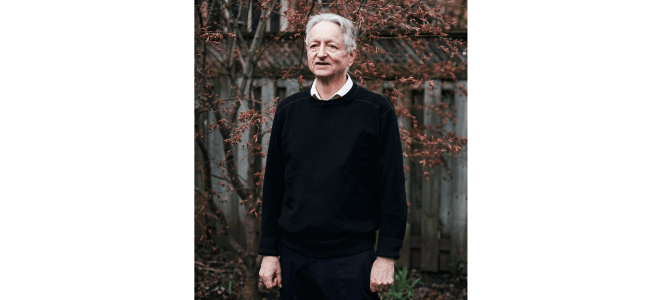
Geoffrey Hinton standing in a backyard.

Image credit: CHLOE ELLINGSON/REDUX

Does the name Geoffrey Hinton mean anything to you? It might not; he never won an election, a Grammy, or a Super Bowl ring. But in the world of cybertechnology and artificial intelligence (AI), he’s more than a rock star, and he made a lot of headlines in May 2023 when he left his job at Google and began publicly expressing his alarm about recent developments in AI. Will Knight, who covers AI as a senior writer for Wired, spoke with Hinton and wrote this May 2023 report.

Continue reading “What Really Made Geoffrey Hinton into an AI Doomer”

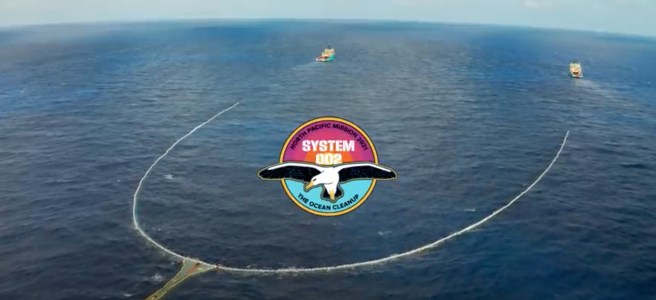
The Ocean Cleanup — “How System 002 Works”

Ocean and horizon with long view of Ocean Cleanup’s System 002 with its two vessels, long net, and retention zone.

Image credit: The Ocean Cleanup

Have you heard of the Great Pacific Garbage Patch? No, it’s not something from Sesame Street (although it sounds like it could be). It’s big, it’s in the middle of the ocean, it’s garbage-y. And it’s real. Ocean Cleanup is an organization that uses innovative techniques to clean up the patch. In addition to their website, they have numerous YouTube videos that explain their techniques and their progress. For our Library, we’ve chosen this short one from October 2021.

Continue reading “The Ocean Cleanup — “How System 002 Works””

Surprising Creatures Lurk in the Great Pacific Garbage Patch

Assorted plastics and other debris float on the surface of the sea.

Image credit: Jakchai Tilakoon/EyeEm/Getty Images

Raise your hand if you think that the tons and tons of plastic garbage floating in the Pacific Ocean are a good thing, something to be preserved and protected. Nobody? No hands up? Good. We all know that it’s ugly and harmful to wildlife; there’s no controversy there. Now, new research shows that it’s even worse than we imagined. Scientific American science writer Meghan Bartels describes a newly researched threat posed by the Great Pacific Garbage Patch in this April 2023 report.

Continue reading “Surprising Creatures Lurk in the Great Pacific Garbage Patch”