Natural Magic

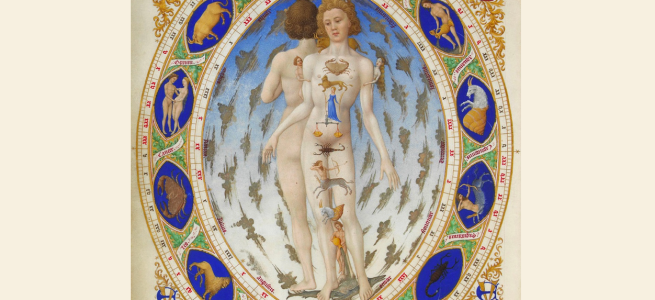
A medieval-style painting of two nude figures, one facing forward and one facing backward, circled by an oval-shaped zodiac calendar.

Modern medicine is magic. Do we mean that literally or metaphorically? Well, yes and yes. For example, a key ingredient in some chemotherapy formulas for cancer—yew—was also an ingredient in the witches’ brew described in Shakespeare’s Macbeth along with “eye of newt and toe of frog.” Yew’s potent and unusual properties have been known to healers and wizards for centuries. Writing professor and author Ellen Wayland-Smith explores the medicine/magic connection more deeply while discussing her own cancer treatment in this March 2021 essay from American Scholar.

Continue reading “Natural Magic”

Why Are So Many Americans Quitting Their Jobs?

An illustration of a man with his back to us facing an open door marked "Exit."

Has the pandemic changed you? What a silly question! Of course it has. Ahhh, but how deeply? In what ways? That question can’t be answered yet, and we may not be able to know for a very long time. In this October 2021 report, writer and journalist Greg Rosalsky, who covers a variety of financial topics for NPR’s Planet Money, investigates some of the reasons for the long arc of pandemic consequences, including the current phenomenon known as the Great Resignation.

Continue reading “Why Are So Many Americans Quitting Their Jobs?”

Why Is Blue So Rare in Nature?

A blue 3D computer generation of a feline.

Why are there no blue tigers? Come to think of it, there are no blue rabbits or squirrels, either. You’ve probably never lost any sleep pondering these questions, but in case you’re just curious, we’ve got some answers for you! Molecular biologist and science writer Joe Hanson made this 2018 video as an episode in his series It’s Okay To Be Smart, a project of PBS Digital Studios.

Continue reading “Why Is Blue So Rare in Nature?”

Making Gender-Neutral Emojis Is More Complicated Than You Think

Picture this: a teacher and a farmer are playfully chatting at a party. You got the image? OK, now here’s a question: in the mental picture you just created, does the farmer have a gender? Does the teacher? English doesn’t require gender marking on those two words the way that many other languages do. Still, all of us who are adults today have been deeply socialized to automatically apply a gender to any other human we encounter, even imaginary ones. That socialization is changing, of course, but while we’re in the midst of the changes, life can get a little complicated. Even emojis can have a hard time; in this November 2020 Wired report, freelance journalist Shira Telushkin explains the complications.

Continue reading “Making Gender-Neutral Emojis Is More Complicated Than You Think”

The Bootleg Fire, the Nation’s Biggest, Gives Scientists an Unexpected Experiment

An airplane drops a cloud of red powder over a forest.

It’s not often that we encounter good news about wildfires, but here is a report that comes close. This July 2021 Associated Press report presented by NPR recounts some of the moderate successes in wildfire mitigation efforts that scientists have been able to observe with the Bootleg Fire in Oregon.

Continue reading “The Bootleg Fire, the Nation’s Biggest, Gives Scientists an Unexpected Experiment”

Breaking the Grass Ceiling: More Women Are Playing College Baseball Than Ever Before

A female baseball player wearing a grey and light blue uniform prepares to hit a ball.

The US has a woman vice president, and there are now women referees on NBA courts and in the broadcast booths. Have women fully broken the glass ceiling? Not quite. In this June 2021 Sports Illustrated report, sports journalist Michael Rosen addresses the “grass ceiling” encountered by women baseball players, specifically, women on collegiate baseball teams.

Continue reading “Breaking the Grass Ceiling: More Women Are Playing College Baseball Than Ever Before”

For Political Cartoonists, the Irony Was That Facebook Didn’t Recognize Irony

A political cartoon about vaccines is being drawn on a tablet.

Have you ever made an ironic remark and had it misinterpreted or misunderstood? Us, too. It happens. In a real-time conversation, you might be able to explain and repair the conversation. Indeed, when the context and intention are clear enough, many potential misunderstandings don’t happen in the first place. On social media, though, things can get more complicated, and ironic intent may not be recognized. New York Times technology correspondent Mike Isaac wrote this March 2021 report on Facebook’s ironic irony problem.

Continue reading “For Political Cartoonists, the Irony Was That Facebook Didn’t Recognize Irony”